Have you ever had a moment when you knew you were safe, but your body didn't seem to get the message?Maybe your heart was racing, your thoughts wouldn't slow down, or you suddenly felt completely overwhelmed. Maybe something reminded you of a difficult experience from the past and, for a moment, it felt like you were right back there again. Or maybe you weren't thinking about anything in particular. You just noticed that you felt disconnected, unsettled, anxious, or not quite like yourself.This is where grounding techniques can be really helpful. Grounding is something I use regularly in therapy, particularly when working with anxiety, trauma, stress, and overwhelming emotions. It can be a simple way of helping your mind and body reconnect with the present moment.Grounding doesn't mean that we are trying to get rid of an emotion or convince ourselves that everything is fine. Instead, it gives us a way to slow things down, notice what is happening, and remind ourselves that we are here, in this moment, and not back in the past.For clients doing EMDR or CPT (click to go to my Services page), grounding can also become an important part of learning how to manage difficult emotions and stay within your window of tolerance (click here to read my blog on the Window of Tolerance).
What Does Grounding Actually Mean?
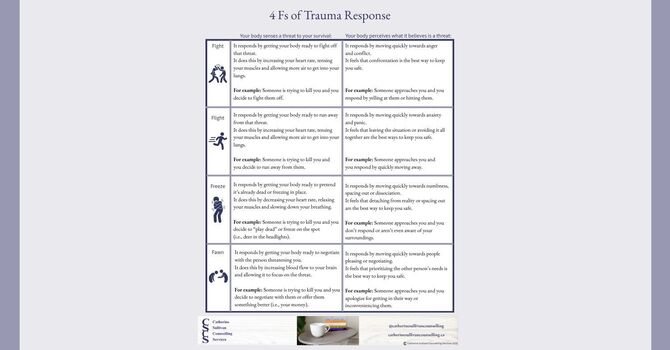
When I talk about grounding with clients, I often describe it as getting yourself back into the present. Our brains and bodies are constantly taking in information. When something feels threatening, overwhelming, or familiar to a previous difficult experience, our nervous system can respond very quickly (click here to read my blog on the 4Fs of trauma response).You might notice:
- Your heart beating faster
- Tension in your muscles
- Racing thoughts
- Feeling on edge
- Feeling disconnected or "checked out"
- Difficulty concentrating
- Feeling like you need to escape
- A strong emotional reaction that seems bigger than the situation
- Feeling like something bad is about to happen
Sometimes our body is responding to something that is happening right now. Other times, our body is responding to something that reminds us of what happened before or is worried about what might happen in the future. Grounding gives us an opportunity to pause and orient ourselves to what is happening right now.You might notice your feet on the floor. You might look around the room. You might take a few slower breaths. You might move your body or focus on a physical sensation. These things sound simple — and they are — but simple doesn't mean ineffective.
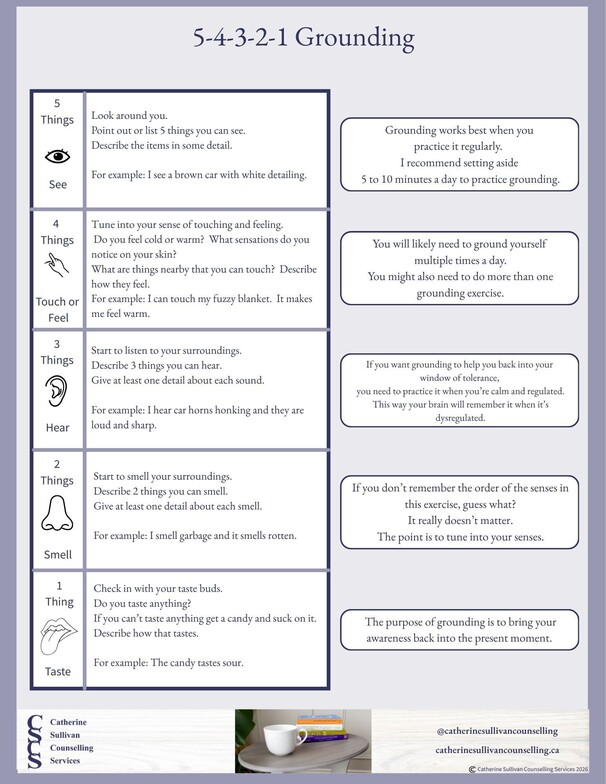
The 5-4-3-2-1 Grounding Technique (click here to download the handout)
One of the grounding techniques I often recommend is the 5-4-3-2-1 exercise .It's a great example of how something very simple can help bring your attention back to the present. You start by looking around you and identifying:
5 things you can see
Look around the room and notice five things.
It might be a picture on the wall, a plant, a lamp, a window, or the colour of the walls.
Try to actually look at each object rather than simply naming it.
4 things you can feel
Notice four physical sensations.
Maybe your feet are touching the floor.
Maybe you can feel your clothing against your skin.
You can also notice temperature, texture, or the sensation of your hands resting on your lap.
3 things you can hear
Pause and listen.
What sounds can you hear?
Maybe there's traffic outside, an appliance running, a dog barking, or someone talking in another room.
2 things you can smell
Notice two smells around you.
If you can't find two, that's okay.
You might notice the smell of your coffee, your shampoo, or simply the smell of the room.
1 thing you can taste
Finally, notice one taste. You might notice the taste in your mouth or take a sip of water.
Or you might grab a candy to suck on.
If you try to do this exercise yourself and you don't remember the exact order of the senses - that's fine. Just do what you can remember.
Breathing Exercises for Grounding
Breathing is another tool that can be helpful when we feel activated. When we're stressed or anxious, our breathing can change. We may start breathing more quickly or shallowly without even realizing it. Bringing some attention to your breathing can help you reconnect with your body.
One simple exercise is to make your exhale slightly longer than your inhale. For example, you might gently breathe in for four seconds and breathe out for six. You don't need to take huge breaths. In fact, some people who are experiencing panic or anxiety find that very deep breathing makes them feel worse. If that is you, don't force it. Instead, try simply noticing your natural breath.
Grounding doesn't always need to look like a formal relaxation exercise. Sometimes the most useful thing is simply noticing that you are here. Click here to see my YouTube videos of grounding breathing exercises.
Grounding Through Yoga and Movement
Grounding doesn't always mean sitting quietly and focusing on your breathing. For some people, movement is actually much more effective. This is one reason I often like incorporating simple yoga-based movements or poses into grounding exercises. You don't need to be flexible. You don't need to have any yoga experience. And you certainly don't need to be able to put your leg behind your head! The purpose isn't exercise. It's about reconnecting with your body.
Mountain Pose (click here to see the YouTube video)
Mountain pose is one of my favourite simple grounding poses.
Stand with both feet firmly on the floor.
Let your arms rest comfortably by your sides.
Notice your feet.
Notice the pressure of the floor underneath you.
Notice your posture.
Legs Up the Wall (click here to see the YouTube video)
If it feels comfortable for your body, lying down with your legs supported against a wall can also be a calming grounding exercise.
Notice the support underneath your body.
Notice the wall behind your legs.
Savasana (click here for the YouTube video)
Lie down on your back.
Have your legs slightly turned out.
Have your arms in a slight V and place them on the floor.
Notice your body connected to the ground and being supported by the ground.
Seated Forward Fold (click here for the YouTube video)
Sit on the ground with your legs straight out in front of you.
Fold forward, hinging at your hips until you can’t go any further.
Let your head hang.
Relax your neck and shoulders.
Grounding and West End Ottawa EMDR
When clients come to me for EMDR, grounding and preparation are an important part of the conversation. There is often a misconception that you start EMDR by immediately processing memories.
EMDR is an eight-phase treatment, and preparation comes before trauma reprocessing. Phase 2 focuses on helping clients understand the process, develop coping strategies, and building resources that can help them manage emotional disturbance during treatment. This can include grounding exercises, breathing, mindfulness, movement, and other individualized resources. I like to use Laurel Parnell’s approach and create what I call a support posse - a group of different types of people you can draw on for specific types of support - that you will need during processing.
Why Grounding Can Be Helpful in Trauma Therapy in West End Ottawa
When we experience something overwhelming, the experience can continue to affect us long after the actual event is over. A sound, smell, place, conversation, relationship, or even a particular thought can sometimes trigger a response that feels much bigger than what is happening in the moment.
This is one reason grounding can be so useful in trauma therapy (see my Services Page for more information on the types of trauma therapy I offer). Before we start working through difficult memories, I want clients to have some tools they can use when emotions become intense. You don't need to be completely calm before doing trauma therapy, but it is important to have ways of coming back to the present when things become overwhelming.
This is particularly relevant in EMDR therapy. Click here to read my EMDR FAQs and find out more. EMDR has eight phases, and Phase 2 is the preparation phase. During this phase, the therapist and client work on developing resources and strategies for maintaining emotional stability during treatment. Some people move through this phase fairly quickly, while others need more time. A significant part of the work is making sure you have the tools and support you need before we ask you to approach those memories.
The Calm/Safe Place in West End Ottawa EMDR
The Calm/Safe Place is a resource that can be developed during Phase 2 of EMDR. The idea is to identify a real or imagined place associated with feelings of calm, comfort, safety, or peace. It could be somewhere you've actually been. It could also be completely imaginary.
What matters is how you feel when you imagine being there. During the exercise, we can pay attention to the details of the experience — what you see, hear, smell, feel, and notice in your body. The goal is to strengthen your ability to access that feeling of calm or safety when you need it.
Once we’ve established your calm place we connect it with a cue word that you can use to recall it easily. For example, your calm place might be your cottage and the cue word is relaxing. You can then use this resource at times when your system starts leave its window of tolerance as a quick way to bring it back into regulation (aka grounding).
The Container Exercise in West End Ottawa EMDR
Another resource that can be useful during Phase 2 is the Container exercise. The Container uses imagery to help you temporarily set aside difficult thoughts, feelings, memories, or worries when you aren't ready or able to work through them. You might imagine putting them into a box, a safe, a vault, a suitcase, or another type of container.
You decide what the container looks like. You decide how it works. And you decide when you want to open it again. I often think of this as giving your brain permission to say: "I don't have to figure this out right now."
That doesn't mean you're ignoring the problem. It means that you can choose when you're ready to engage with something. This can be especially helpful between therapy sessions when a difficult memory or thought comes up at a time when you don't have the space to process it. It can also be helpful for memories that you don’t want to process right away but that are still causing you distress.
Grounding and West End Ottawa CPT
Cognitive Processing Therapy, or CPT, is a trauma-focused therapy that helps people examine the thoughts and beliefs that can develop following traumatic experiences. Click here to read my CPT FAQs to learn more. CPT involves talking about the impact of trauma and looking at the ways our thinking can become affected by what we've experienced. That can bring up strong emotions.
Grounding can give you something to use when you notice yourself becoming overwhelmed during or between sessions. For example, if you notice your thoughts becoming increasingly intense while working through a difficult CPT exercise, you might pause and notice your feet on the floor, take a few comfortable breaths, or look around the room and orient yourself to the present.
Which Grounding Technique Is Right for You?
There isn't one grounding technique that works for everyone. You might love the 5-4-3-2-1 exercise. You might hate focusing on your breathing. You might find yoga incredibly grounding. Or you might find that standing up, walking around the room, and noticing your surroundings works much better.
It's about finding the things that your nervous system responds to. And sometimes what works changes depending on the day. The grounding technique that works when you're mildly stressed might not be the same one you need when you're highly activated.The more tools you have, the more choices you have.
Practicing Grounding Before You Need It
One of the best ways to make grounding useful is to practice it when you aren't already overwhelmed. If you practice grounding when you’re calm it will be easier to access when your body starts to feel overwhelmed. I recommend setting aside 5 minutes in the morning and 5 minutes in the evening to practice grounding.
The other important thing to note about grounding is that it’s something you’ll likely need to use on a regular basis when you first start therapy. This is because you’ll be talking about events and bringing up emotions that you might not have thought about for years or that your body has been trying to keep contained. You’ll likely need to do grounding exercises multiple times a day. This doesn’t mean that you’re doing something wrong or that therapy isn’t working. In fact it’s the exact opposite.The goal is to become familiar with these skills so they aren't completely new when you really need them. Grounding is a skill, and like any skill, it becomes easier with practice.
Coming Back to the Present with West End Ottawa Trauma Therapy
For me, one of the most important things about grounding is that it isn't about pretending that difficult experiences didn't happen. It's not about minimizing trauma. It's not about telling yourself to "just calm down." And it's not about pushing uncomfortable feelings away.
It's about recognizing that something happened then, and you are here now. These are small things, but they can become powerful tools over time. Whether you're working through trauma using EMDR, CPT, or another form of trauma therapy, learning how to ground yourself can help you feel more connected to your body, more present in the moment, and more confident in your ability to handle difficult emotions.