Have you ever wondered why you reacted the way you did in a difficult or frightening situation?
Maybe you became angry and argumentative. Maybe you suddenly needed to get away. Perhaps your mind went completely blank and you felt unable to move or speak. Or maybe, despite being uncomfortable, you found yourself apologizing, people-pleasing, or trying desperately to make the other person happy.
The answer may have something to do with the nervous system's response to perceived threat. When we experience something as threatening, our bodies and brains are designed to respond quickly. We don't consciously choose every aspect of this response. Instead, our nervous system can move us toward behaviours that have helped us survive, cope, or feel safer.
The four commonly discussed trauma responses are fight, flight, freeze, and fawn.
Understanding these responses can be an important part of trauma therapy (either EMDR or CPT) because it can help us replace self-blame with curiosity and compassion. Rather than seeing ourselves as "overreacting," "too sensitive," "difficult," or "weak," we can begin to understand that our responses may have developed for a reason.
What Are the 4 F's of Trauma Response?
The four F's—fight, flight, freeze, and fawn—are different ways the nervous system can respond to a perceived threat.
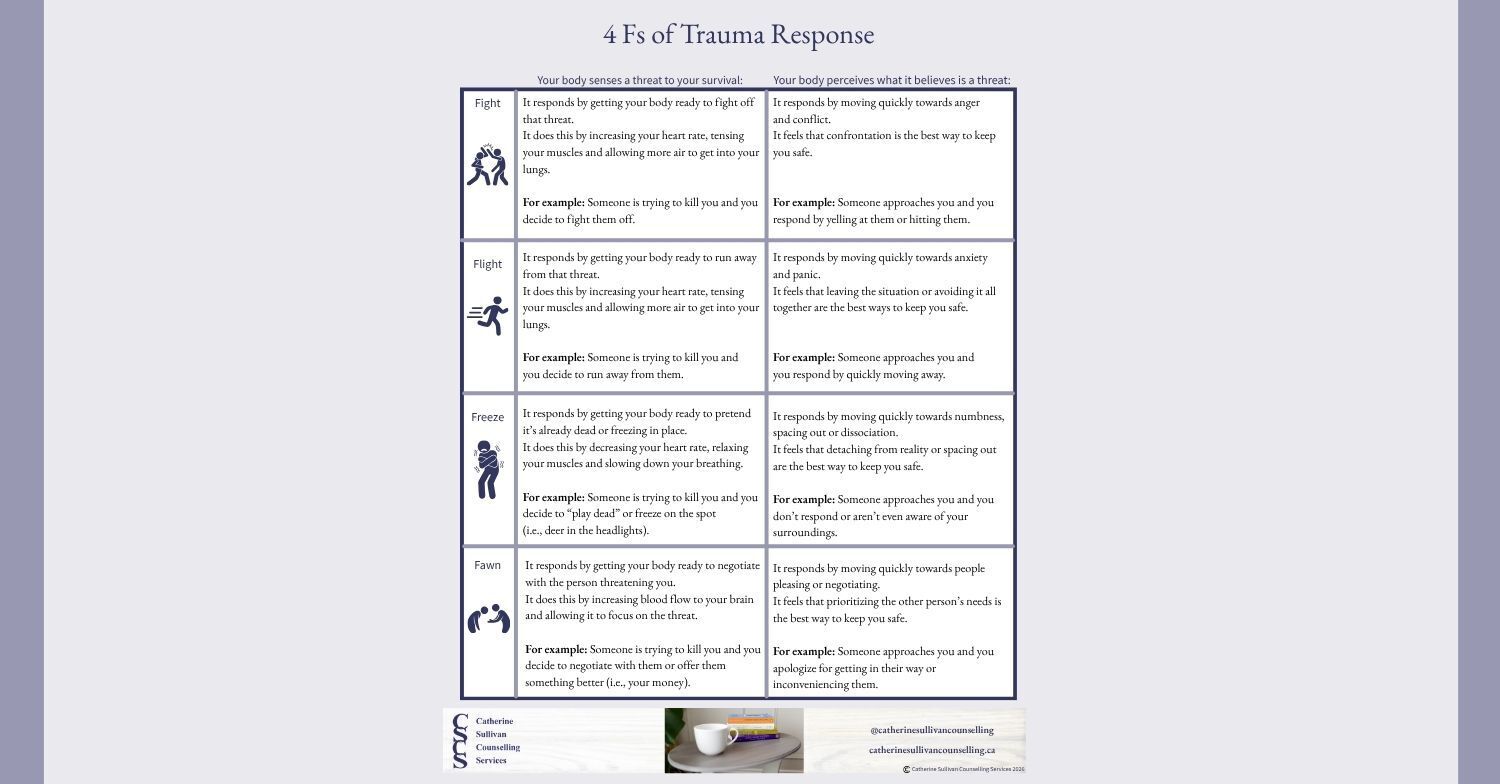
The accompanying 4 F's free handout illustrates an important distinction: there can be a difference between what our body senses as a threat and what our brain perceives or believes is a threat.
For example, your body may react with increased heart rate, muscle tension, and rapid breathing when it senses danger. At the same time, your brain may interpret what is happening and move you toward anger, anxiety, panic, numbness, dissociation, or people-pleasing. In other words, these responses involve both our physical reactions and the behaviours or emotional responses that follow.
Fight: Understanding the Fight Response in Trauma Therapy in West End Ottawa
The fight response is often associated with anger, confrontation, or a strong urge to defend yourself.
When the body prepares for fight, it can increase heart rate, tense the muscles, and increase alertness. These physical changes make sense from a survival perspective. If there is an immediate physical threat, the body needs to be ready to respond.
For some people, it might look like becoming argumentative, yelling, criticizing, becoming defensive, or feeling an overwhelming need to prove a point. You may notice that you become particularly activated when you feel criticized, rejected, controlled, dismissed, or misunderstood.
The important question isn't simply, "Why am I so angry?", It’s: "What is my nervous system responding to right now?"
Sometimes anger is protecting something underneath it—fear, hurt, shame, helplessness, or a feeling of being unsafe. For example, imagine someone approaches you and you immediately begin yelling or become physically aggressive. Your brain may perceive confrontation as the best way to protect yourself. Understanding the response isn't the same as excusing harmful behaviour. Rather, understanding can give us a starting point for changing the pattern.
EMDR (see EMDR blog post) can help people recognize what activates their fight response and develop different ways of responding when they are no longer in immediate danger.
Flight: How Trauma Therapy Can Help With the Urge to Escape
The flight response is the urge to escape. Just as with fight, the body can prepare for action by increasing heart rate, tensing muscles, and increasing alertness. The difference is what happens next: instead of moving toward the perceived threat, the person wants to move away from it. Flight can be very obvious. You might physically leave a situation, avoid someone, or feel an intense urge to get out. But flight can also show up in less obvious ways.
You might:
- Avoid difficult conversations
- Stay extremely busy so you don't have time to think
- Become anxious about situations that feel unpredictable
- Avoid places, people, or activities that remind you of something difficult
- Experience panic when you feel trapped or unable to leave
For some people, anxiety and panic are closely connected with their flight response. The nervous system is essentially saying, Something is wrong. I need to get out of here. The challenge is that avoidance can provide immediate relief while reinforcing the idea that the situation is dangerous. This is one reason trauma therapy can be helpful (see my Services Page for more information). Rather than forcing yourself to "just stop avoiding," therapy can help you understand what your nervous system has learned and gradually develop a greater sense of safety.
Freeze: Understanding Dissociation Through Trauma Therapy
The freeze response can be one of the most confusing trauma responses. Instead of fighting or running away, the person may become still, numb, disconnected, or unable to respond.
The handout accompanying this article describes freeze as the body's attempt to prepare as though it is already dead or to remain completely still. Physiologically, this can involve a decrease in heart rate, relaxation of the muscles, and slower breathing. From the outside, someone experiencing a freeze response may appear calm. Inside, however, they may feel completely overwhelmed.
Freeze can look like:
- Being unable to find words
- Feeling physically unable to move
- Feeling numbStaring into space
- Feeling disconnected from your body
- "Checking out" during stressful situations
- Feeling as though you are watching yourself from a distance
Freeze can also overlap with dissociation. Dissociation is a way the mind can create distance from an overwhelming experience. It may involve feeling disconnected from your thoughts, feelings, body, surroundings, or sense of reality. But a freeze response isn't a conscious decision to do nothing. It is a nervous system response. Your body may have determined, in that moment, that becoming still or disconnected was the safest available option.
Fawn: Trauma Therapy for People-Pleasing
The fawn response involves moving toward people-pleasing, appeasing, negotiating, or prioritizing another person's needs over your own, in an attempt to create safety.
Instead of fighting the threat or escaping from it, the person tries to make the threat less threatening. For example, imagine that someone is angry with you. You immediately apologize—even though you haven't done anything wrong. You might take responsibility for their feelings, try to calm them down, agree with them, or do whatever you can to avoid conflict.
Fawning can look like:
- Saying yes when you desperately want to say no
- Apologizing constantly
- Avoiding conflict at almost any cost
- Taking responsibility for other people's emotions
- Trying to anticipate what others need
- Changing your opinions to avoid upsetting someone
- Having difficulty setting boundaries
- Feeling responsible for keeping everyone happy
- Staying quiet about your own needs
People who experience a strong fawn response may be incredibly caring, thoughtful, and empathetic. These are wonderful qualities. The difficulty arises when caring for other people consistently comes at the expense of caring for yourself. Over time, you lose touch with what you actually want or need.
Why Do We Have Trauma Responses?
Trauma responses are ways that our body has adapted to responses that are intended to ensure our survival. On the handout the first column shows the evolutionary response to each of the 4Fs. It gives an example of how that response is intended to ensure our survival.
For example with fight: if we find ourselves in a situation where our survival is being threatened our body quickly decides that fighting is the best response. This could mean fighting off an attacker that is either human or an animal.
If we repeatedly find ourselves in situations where these responses are activated they turn into trauma responses. In this case our body responses to things it “perceives as threatening” vs. things are actual survival threats. This is a response that evolves over time as our body is repeatedly exposed to situations where it does not feel safe. Once it learns that responding with one of the 4Fs works to help calm the nervous system it continues to activate this response even though the threat is not an imminent threat to our survival
How West End Ottawa EMDR Can Help Process Trauma Responses
If you recognize yourself in one or more of the four F's, you may benefit from working with a therapist who understands trauma and the nervous system. EMDR (Eye Movement Desensitization and Reprocessing) is one approach used in trauma therapy.
EMDR can help people process distressing memories and experiences that continue to affect them in the present. Rather than simply talking about what happened over and over, EMDR uses a structured approach that can help the brain process memories that remain distressing or feel "stuck."
For someone who experiences a strong fight, flight, freeze, or fawn response, EMDR can provide an opportunity to explore experiences and beliefs connected to those reactions. For example, someone who learned that conflict was dangerous may automatically move into flight or fawn when another person becomes upset. Someone who learned that they needed to defend themselves may move quickly into fight.
EMDR can help you better understand why you tend towards these responses and how to start using ones that are more helpful. The goal isn't to criticize the response. It's to understand what it has been trying to accomplish and help you develop a greater sense of safety in the present.
How CPT in West End Ottawa Can Help You Understand Trauma-Related Thoughts and Beliefs
CPT (Cognitive Processing Therapy) takes a somewhat different approach to trauma therapy. CPT focuses on the thoughts and beliefs that can develop following trauma.
For example, someone might develop beliefs such as:
- "I can't trust anyone."
- "It's my fault."
- "I have to keep everyone happy."
- "If I make a mistake, something terrible will happen."
- "I have to be in control all the time."
- "The world isn't safe."
CPT can help people examine these beliefs and consider whether they are still serving them in the present. This can be particularly helpful when your trauma response is connected to beliefs about safety, control, trust, self-worth, or responsibility.
Can You Have More Than One Trauma Response?
Absolutely. People don't necessarily have one fixed trauma response. You may even move through several responses during the same experience.
For example, you might initially freeze during an argument. Then, once you begin to feel more activated, you might move into fight. Later, you may apologize and try to make the other person happy because you're worried about the consequences of the conflict.
Our nervous systems are constantly taking in information and trying to figure out what will keep us safe. The goal isn't to eliminate these responses. They can help us react quickly when there is genuine danger. The goal is to develop more flexibility—to be able to recognize when your nervous system is responding to an old threat and give yourself more choices about how to respond in the present.
Learning to Notice Your Trauma Responses
One of the first steps toward changing these patterns is simply noticing them.You might start paying attention to what happens in your body when you feel stressed. None of these observations are judgments. They're information.
Over time, you may begin to recognize your own early warning signs. That awareness can create a small but important space between what happens and how you respond. And sometimes that small space is where change begins.
Frequently Asked Questions About the 4 F's of Trauma Response
What are the 4 F's of trauma response?
Answer: The four commonly discussed trauma responses are fight, flight, freeze, and fawn. Fight involves moving toward confrontation, flight involves trying to escape, freeze involves becoming still or disconnected, and fawn involves attempting to create safety through appeasing or pleasing another person.
Does having a fight, flight, freeze, or fawn response mean I have trauma?
Answer: Not necessarily. These are normal human responses to perceived danger and stress. Experiencing one of these responses doesn't automatically mean you have experienced trauma.
However, traumatic experiences can influence how your nervous system responds to situations in the present. If your reactions feel intense, automatic, or difficult to control, trauma therapy may help you understand what is happening.
Why do I freeze when someone is angry with me?
Answer: Freezing can be a protective response when your nervous system perceives a situation as overwhelming or unsafe. You may feel unable to speak, move, think clearly, or respond.
It doesn't mean that you are weak or that you are choosing not to stand up for yourself. Your nervous system may be attempting to protect you in the way it has learned is safest.
Is people-pleasing a trauma response?
Answer: People-pleasing can sometimes be associated with the fawn response, particularly when someone has learned that keeping other people happy, avoiding conflict, or anticipating another person's needs helps them feel safe.
However, people-pleasing can have many different causes. A therapist can help you explore where your particular patterns come from.
Can EMDR help with fight, flight, freeze, or fawn responses?
Answer: EMDR can be used as part of trauma therapy to help process distressing memories and experiences that may contribute to ongoing emotional or nervous-system responses.
Can CPT help with trauma responses?
Answer: Yes. CPT (Cognitive Processing Therapy) focuses on identifying and examining thoughts and beliefs related to traumatic experiences.
For example, if you frequently fawn because you believe that conflict is always dangerous or that you are responsible for everyone else's feelings, CPT may provide a structured way to examine those beliefs.
Will trauma therapy get rid of my trauma response(s)?
The goal isn't necessarily to eliminate your nervous system's ability to respond to danger. Fight, flight, freeze, and other stress responses serve important protective functions.
Instead, trauma therapy in West End Ottawa can help you develop greater awareness and flexibility so that your nervous system doesn't automatically respond to situations as though you are still experiencing the original threat.
Final Thoughts: Your Trauma Response Is Trying to Protect You
The next time you notice yourself reacting strongly to something, try pausing before judging yourself. Instead of asking, "Why am I like this?", consider asking: "What is my nervous system trying to protect me from?"
Sometimes the reaction that feels frustrating in the present is a response that once helped you cope. You may simply need to help it learn that things are different now.
That is one of the important goals of trauma therapy: creating enough safety in the present that your nervous system no longer has to rely so heavily on the survival strategies that once helped you get through the past.
Whether through EMDR, CPT, or another trauma-focused approach, healing can involve learning to recognize these patterns, understand them, and gradually develop more choice in how you respond.
Your nervous system has been trying to protect you. You can learn to work with it—not against it.


.jpg)